Blank Squares and Empty Pixels: How British Activists Turned Digital Silence Into a Roar
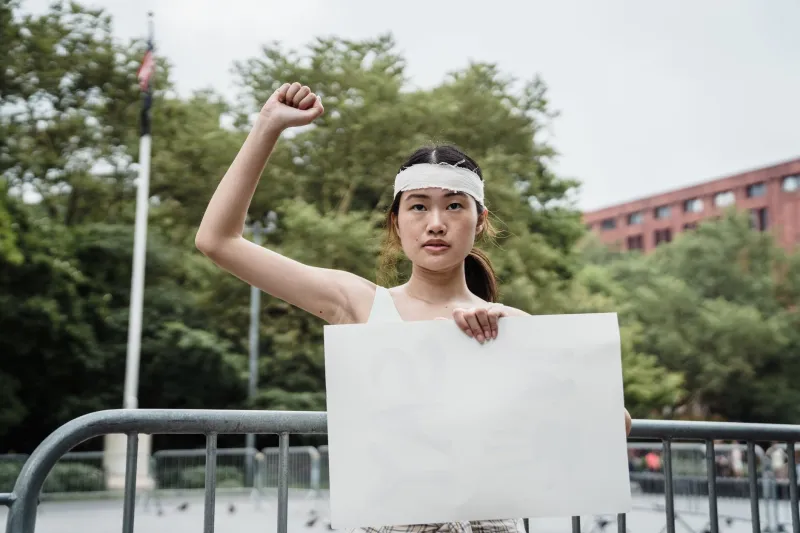
There's something quietly radical about doing nothing. In a space built entirely on the premise that everyone contributes — that the whole point is to place something — choosing not to is a statement in itself. And a growing number of British communities have figured that out, turning r/place's own logic against it to stage some of the most inventive acts of digital protest the internet has quietly witnessed.
This isn't about trolls or griefers looking to cause chaos. What's been happening on r/place — particularly during the 2022 and 2023 events — is more considered than that. Organised, deliberate, and in some cases surprisingly effective at drawing real-world attention.
The Art of the Void
For the uninitiated, r/place works because everyone wants to fill space. Leaving a gap feels almost physically uncomfortable to the communities involved — it's an invitation for rivals to swoop in. That's precisely why some groups started using blank space as a weapon.
During the 2022 event, a loose coalition of UK-based environmental activists coordinated through Discord and several subreddits to create and maintain a deliberately empty rectangle in a contested area of the canvas. The void sat adjacent to imagery associated with fossil fuel branding that other users had erected — and the activists' argument was simple: they wouldn't dignify it with a border, a response, or even a colour. The blank space, they argued in their Discord server (screenshots of which circulated widely on Reddit), was meant to represent "the silence of institutions that should be speaking up."
It sounds abstract. But it worked as a conversation starter in a way that a counter-artwork might not have. People noticed the gap. They asked questions. Posts explaining the boycott racked up thousands of upvotes.
Erasure as Expression
Beyond the strategic void, other British communities took a more active approach: coordinated erasure. Rather than building something new, they organised pixel-by-pixel campaigns to overwrite existing artworks they found objectionable — or, in some cases, to reclaim territory that had been taken from them.
One particularly documented instance involved a Northern English community group whose regional emblem had been overwritten by an unrelated international faction. Rather than simply rebuilding, they launched what they called a "rolling blank" — methodically turning the offending artwork white, one pixel at a time, before placing their own design on top. The process was slow, painstaking, and entirely public. It attracted spectators. People tuned in on Twitch streams just to watch the erasure unfold in real time.
The symbolism wasn't lost on the participants. "It felt like we were reclaiming something," one organiser later wrote on the community's subreddit. "Not just the pixels. Something bigger."
Local Grievances, Global Canvas
What's striking about many of these campaigns is how intensely local their motivations were, even when playing out on a platform with a global audience. Housing campaigners from Bristol briefly organised a pixel strike in solidarity with a local planning dispute. A community in Scotland used coordinated non-participation in a particular region of the canvas to draw attention to broadband inequality — arguing, with some wit, that the digital divide meant their community was already being left blank.
These weren't always polished operations. Some fizzled out. A few attracted mockery. But the fact that they happened at all says something interesting about where political energy is flowing in modern Britain. When traditional channels feel blocked or ignored, people find new ones — and sometimes those new channels are a 2,000-by-2,000-pixel grid on Reddit.
Dr. Priya Chandran, a researcher who has written about digital protest movements at a UK university (and who asked that her institution not be named, as her work is ongoing), told us she finds the r/place examples genuinely significant. "What you're seeing is communities adapting the tools available to them," she said. "The medium becomes the message in a very literal sense. The act of withholding participation, or of erasing, carries meaning precisely because everyone understands the rules of the space."
When the Protest Backfired
Not every pixel boycott landed as intended. At least one organised campaign — centred around a dispute that, frankly, reads more like an internet argument than a genuine political cause — ended up drawing more attention to the thing it was trying to suppress. By leaving a deliberate void next to contested imagery, the boycotters inadvertently created a visual marker that made the offending artwork easier to find.
There's a lesson there about the limits of this kind of protest. R/place moves fast, alliances shift, and the absence of pixels doesn't come with a caption explaining itself. Without sustained communication off-canvas — the Discord servers, the subreddit posts, the Twitch streams providing running commentary — the gesture risks becoming invisible noise rather than meaningful silence.
What It All Means
Step back from the individual campaigns and a broader picture emerges. R/place, for all its chaotic energy, has become something of a pressure valve for a particular strain of British online culture — one that's creative, community-oriented, and increasingly willing to use unconventional methods to make a point.
The pixel boycott, in its various forms, sits in a long tradition of British protest ingenuity. From the suffragettes' hunger strikes to the empty chairs left at Parliament by campaigners, there's a history here of using absence and refusal as political tools. That this instinct has found its way onto a collaborative internet canvas feels less surprising the more you think about it.
What r/place offers that a picket line doesn't is visibility at scale, combined with a built-in audience of millions who are already paying attention. The canvas is always being watched. Every blank square is a question waiting to be answered.
And sometimes, in the right context, the most powerful thing a community can do is simply refuse to fill it in.
Have you been involved in an organised r/place campaign — political or otherwise? We'd love to hear your story. Drop us a line through the rPlace UK contact page.